
Digital marketing trends 2026 — what's working right now and what to leave behind
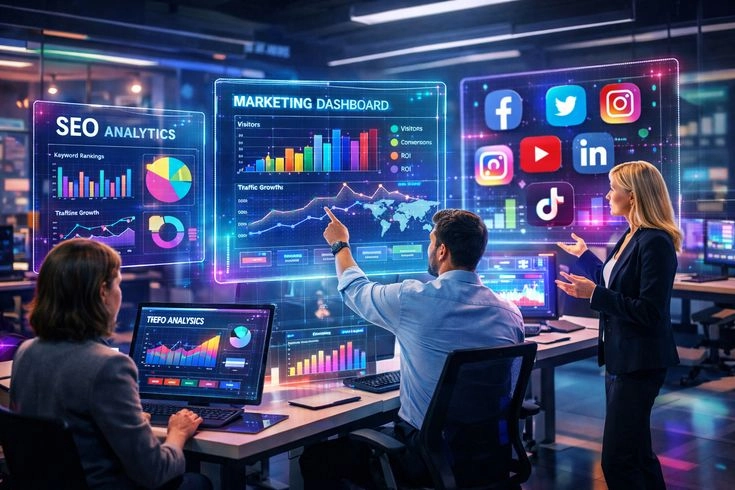
Digital marketing in 2026 looks nothing like it did three years ago. AI has reshaped how content is created, how ads are targeted, and how customers discover brands. The marketers thriving right now are not the ones chasing every new tool — they are the ones who understand which shifts are fundamental and which are noise.
This post breaks down the trends that are genuinely moving the needle in 2026, and the outdated thinking you need to leave behind.
1. AI-assisted marketing is now the baseline, not the edge
Every serious marketing team is using AI somewhere in their workflow — for content drafts, audience segmentation, ad copy testing, or campaign reporting. The competitive advantage is no longer in using AI at all. It is in using it well.
The brands winning in 2026 treat AI as a first draft engine and a data analyst, not a content replacement. Human strategy, brand voice, and creative judgment remain the differentiator. If your content reads like it was generated and published without review, your audience will notice — and so will Google.
“AI doesn’t replace the marketer. It removes the excuse for slow, generic, low-effort work.”
What to do: Audit every step of your content and campaign workflow. Where are you spending time on tasks AI could handle in seconds? Redirect that time into strategy, positioning, and creative direction.
2. Short-form video is still king — but depth is making a comeback
Short-form video on Instagram Reels, TikTok, and YouTube Shorts continues to dominate reach and discovery. But something interesting is happening alongside it: long-form content is recovering. Audiences exhausted by endless short clips are returning to podcasts, long YouTube videos, detailed newsletters, and in-depth blog posts.
The brands with the strongest audiences in 2026 are doing both. Short-form video for discovery and top-of-funnel reach. Long-form content for trust, depth, and conversion.
What to do: Do not abandon short-form video. But pair it with at least one long-form channel — a newsletter, a podcast, or a content-rich blog — where you can go deeper with the audience you have already earned.
3. Zero-click content is a real strategy, not a consolation prize
More than 60% of searches now end without a click. AI Overviews, featured snippets, and knowledge panels answer questions before users ever visit a website. Many marketers see this as a threat. The smarter response is to treat it as an opportunity.
Brands that appear in AI-generated answers, featured snippets, and knowledge panels are building visibility and authority even when users do not click through. That visibility shapes buying decisions, brand recall, and trust — all of which drive conversions later.
What to do: Structure your content to answer specific questions directly and concisely. Use clear headings that mirror what people search for. Build topical authority by covering your subject area deeply, not just broadly.
4. First-party data is now a competitive advantage
Third-party cookies are effectively finished. Brands that relied on them for retargeting and audience building are scrambling. Brands that spent the last two years building their own email lists, CRM databases, and customer communities are pulling ahead.
Your email list, your customer data, your loyalty programme — these are assets no algorithm change or platform policy can take away from you. In 2026, first-party data is the foundation of every high-performing paid and organic strategy.
What to do: Every piece of content you publish should have a clear path to capturing first-party data — an email signup, a lead magnet, a quiz, or a community invite. Stop sending traffic to platforms you do not own.
5. Brand building is back as a performance strategy
For years, digital marketing optimised relentlessly for short-term conversion. Click this, buy now, limited time offer. That approach is hitting diminishing returns as ad costs rise and consumer trust falls.
The brands growing fastest in 2026 are investing in brand — consistent positioning, distinctive creative, thought leadership, and community. Not because brand is soft or unmeasurable, but because it is the thing that makes every other marketing channel work better. Branded search volume, direct traffic, and customer lifetime value all rise when brand is strong.
What to do: Identify one clear point of view your brand stands for — something specific, not generic — and express it consistently across every channel. Brand is not about logos and colours. It is about what you reliably stand for.
What to leave behind in 2026
- Publishing AI content without editing or adding genuine insight
- Chasing follower counts on platforms your audience does not use
- Optimising only for clicks when visibility and citation matter just as much
- Running paid ads without a strong organic and email foundation to support them
Treating every marketing channel as separate rather than building an integrated strategy
Digital marketing in 2026 rewards clarity, consistency, and genuine usefulness. The fundamentals — know your audience, create real value, build trust over time — have not changed. What has changed is the speed, the tools, and the channels. Master those fundamentals first, and everything else becomes easier.